
Over the past eight years at NTHU, my research has centered on the novel field I coined "amorphous and metamorphous materials and structures." These entities exhibit distinctive mechanical and electromagnetic properties, which, when harnessed, lead to the creation of innovative applications. By manipulating the interactions between waves and these engineered materials or structures, we can generate exceptionally broadband, tunable, and advanced material and electromagnetic properties.
My exploration into these materials dates back to the early 2000s while I was a faculty at University of Washington, during which I developed various structures to validate the conceptual framework. Recent results have been published, covering diverse concepts such as optical image encryption [1-4], wave manipulation [5-7, 28], extreme broadband energy harvesting through antenna and rectifier designs [8, 9, 12, 13, 17, 18, 19], and thermoelectric and pyroelectric designs [12-14]. Simultaneously, we've been actively investigating existing metamaterials to comprehend their potentials and limitations [10, 20-23]. Building on this foundation, we've created enhanced and more advanced versions of these metamaterials [11, 17]. These investigations have also paved the way for our exploration of the Terahertz frequency band, which exhibits remarkable properties and applications [8, 14-17]. Despite the unique challenges posed by the size/wavelength convergence in THz, the potential for valuable new devices and applications, such as imaging and wave manipulation [13-18, 26, 28], has motivated our research.
RESEARCH
Recent Advances and Breakthroughs
1. Liquid Enigma machine and reconfigurable wave manipulator: A new way to shape light and waves
In one demonstration, we used a thin layer of liquid to create what could be described as a temporal and spatial analog of the Enigma machine — an encryption device that changes continuously, both over time and across its surface.
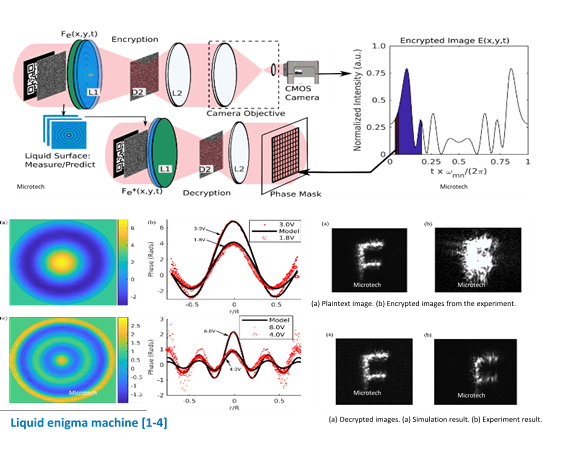
Traditional optical encryption systems, such as double random phase encoding (DRPE), rely on static patterns to secure data. Our system adds another dimension of protection by making the encryption key move and evolve over time, creating zillions of possible key states and dramatically increasing security [1–4].
This technology has already led to a U.S. patent [4], several journal and conference papers, and multiple new publications in progress. It’s a vivid example of how the boundaries between materials, optics, and computation are starting to blur.
In parallel, we’ve been using liquid crystals—the same materials used in displays—to show how wave behavior can be programmed and reprogrammed dynamically.
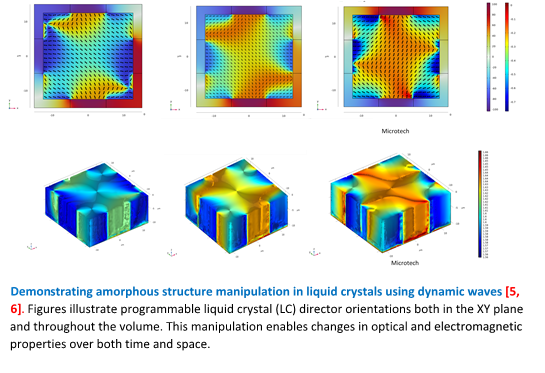
By controlling frequency, voltage, and electrode placement, we created tunable and reconfigurable 3D liquid crystal devices capable of generating intricate, time-varying optical patterns [5]. The result is a system that can change how it bends, filters, and directs light—almost like giving the material its own personality
These experiments demonstrate that we can “teach” materials to remember and respond to external signals, paving the way for devices that adapt on their own, with applications in advanced optics, adaptive structure, and next-generation electromagnetic systems. This work has also led to a U.S. patent filing [7] and ongoing experimental studies now under review [6].
2. Shaping the Invisible and the See-Through: Metamaterials and Terahertz Electronics & Photonics
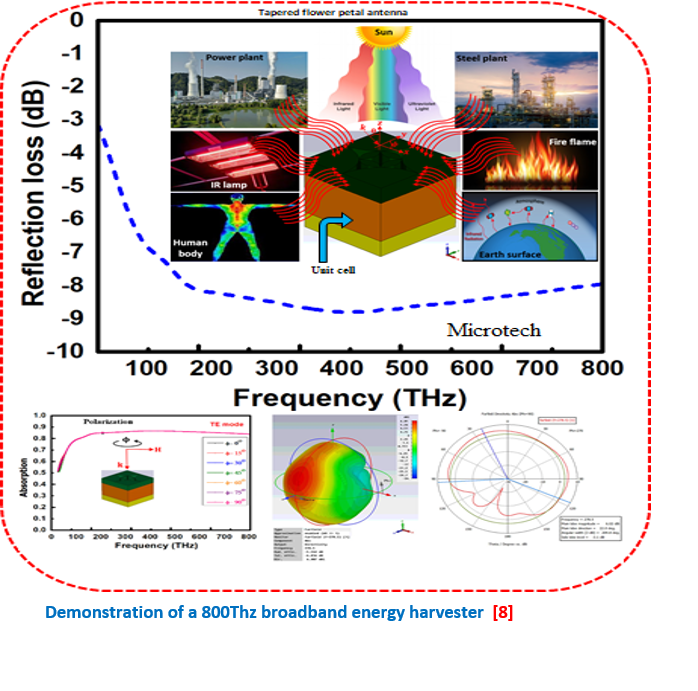
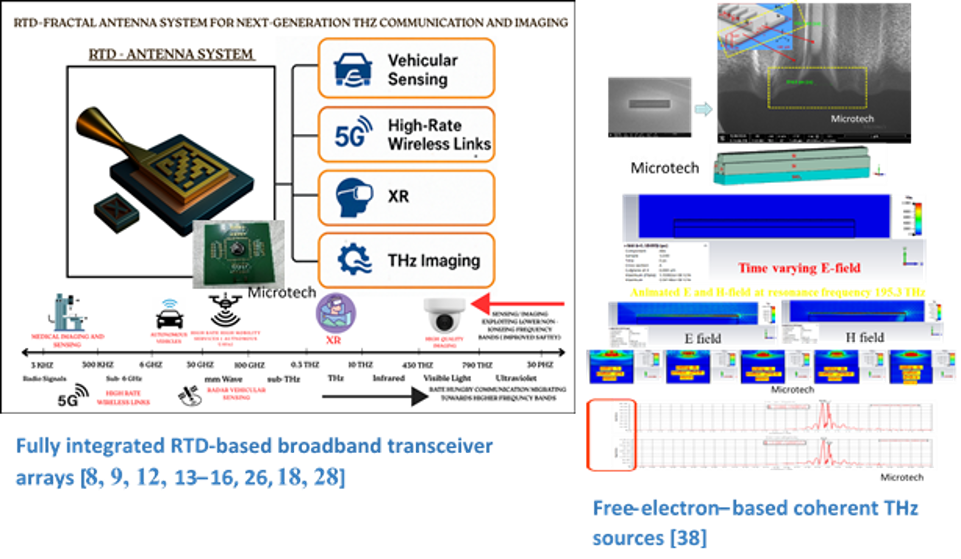
Our research is redefining what’s possible in terahertz (THz) technology, bridging the worlds of electronics and photonics to build devices that can sense, communicate, and even harvest energy in entirely new ways. By combining advanced metamaterials, reconfigurable antennas, and innovative THz devices, we are learning how to bend, steer, and control electromagnetic waves with unprecedented precision — opening doors to the next generation of imaging, sensing, and communication systems [5–10, 13–18, 26–28, 38].
At the heart of our work are ultra-broadband antennas that can capture and manipulate energy from light waves ranging from the infrared (IR) to the UV-visible spectrum (Figure above). One of our key designs, inspired by flower petals - achieves an impressive 84.5% absorption efficiency across frequencies from 25 THz to 800 THz, and remains stable at different angles and polarizations [8, 9, 13, 14].
We have also created tunable and extremely broadband antenna and absorber systems, capable of adjusting their response in real time, much like an adaptive receiver that automatically tunes to the right signal [9, 18, 19]. These innovations have led to multiple U.S. PCT patents filed between 2021 and 2022, demonstrating their potential for energy harvesting and broadband communication [13–16].
For tunable antenna design, Minkowski Fractal [18] and tunable fractal designs [12] were later published in 2020 and 2023, respectively, showcasing the ongoing progress in this area of study. These efforts have led to a series of discoveries—materials and devices that can bend, steer, and even cloak electromagnetic waves, paving the way for transformative applications in imaging, sensing, and communication.
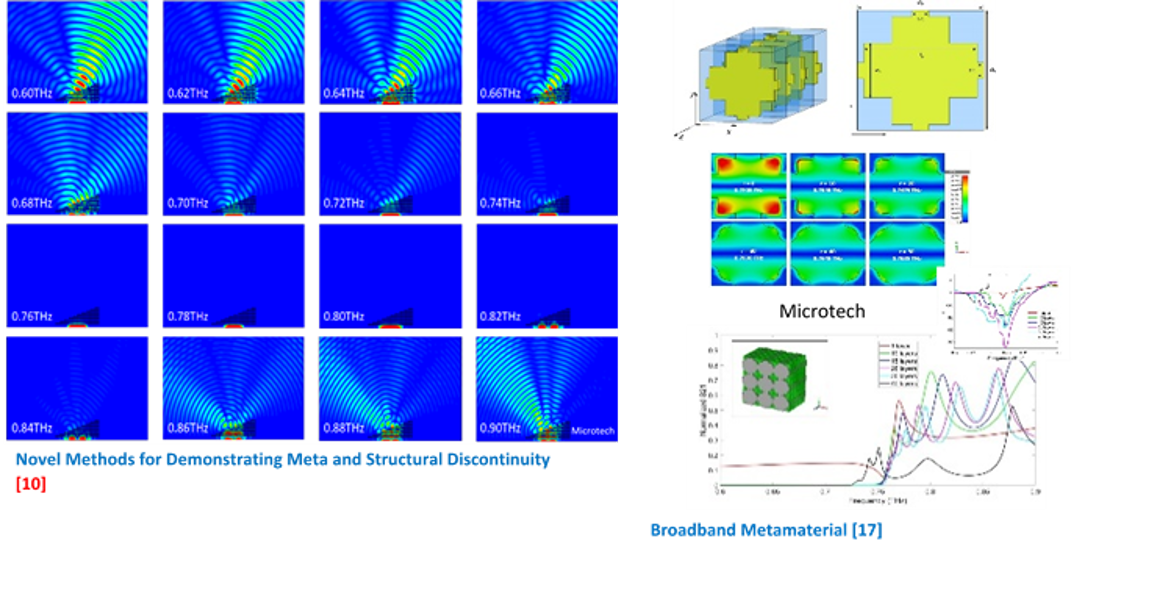
Beyond antennas, we explore metamaterials — specially engineered materials that interact with waves in remarkable ways. We study designs with both continuous and discontinuous refractive indices, demonstrating that these unusual structures can exist and function in the real world [10] (left figure). Through geometric modeling and phased-array experiments, we confirmed positive, negative and discontinuous refraction at resonance frequencies, showing that these materials not only can bend light backward - a phenomenon that hints at future technologies beyond wave cloaking or perfect imaging but also many more applications we will reveal in the near future[10].
We also have developed many innovative structures, including arm-shift [11], multilayer [17] (right figure), Minkowski fractal [18], and tunable fractal designs [12]. These examples show how carefully engineered geometry can produce extreme broadband and adaptive optical responses. Our studies, spanning ultra-broadband frequencies from 25 THz to 800 THz and including discontinuous metamaterials, published in Nature Scientific Reports [8, 10], demonstrate how relatively simple structures can manipulate light and energy beyond natural limits, forming a critical foundation for the future of THz science.
On the electronic side, we are building quasi-optical RTD-based transceiver systems [13–16, 26] - fully integrated THz devices that combine high-speed electronics with optical precision. These systems are paired with the ultra-broadband and tunable antennas described above [8, 9, 12, 14, 18, 28]. These systems can capture and transmit signals across extremely wide frequency ranges, enhancing the versatility of THz technology (left figure).
We are also advancing free-electron–based coherent THz sources [38] (right figure) and recently introduced a Josephson Threshold Detector, a breakthrough device that dramatically improves how efficiently THz radiation can be detected.
Together, these developments bridge the gap between electronics and photonics, laying the foundation for next-generation THz imaging, communication, and sensing platforms, while also giving rise to entirely new electromagnetic materials that are truly metamaterials and beyond.
3. From Moving Mirrors to Moving Light: The Evolution of THz and Optical Scanners
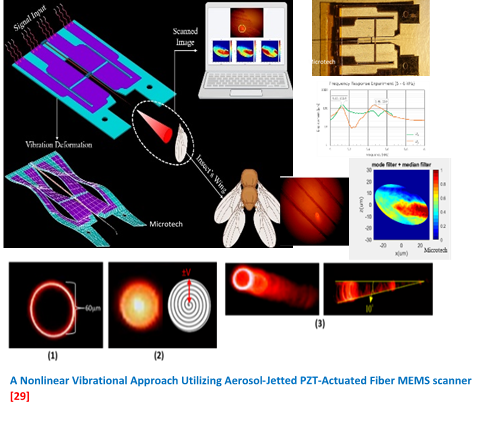
Our journey began with a bold idea — to make optical scanners so small and precise that they could fit inside a needle or fiber. Early on, we developed mechanical and non-mechanical optical scanning imaging systems [29, 30–37], culminating in a world-first demonstration: a MEMS-based Cantilever Waveguide Scanner that uses nonlinear mechanical vibration to transform 1D motion into a full 2D scanning pattern (figure below).
This device, published in Nature Microsystems and Nanoengineering [29], achieves precise optical scanning using only a tiny vibrating beam - a leap that opened new possibilities for real-time 3D endoscopic imaging. Funded initially by the U.S. NIH (R01) and later by Taiwan’s Ministry of Science and Technology (MOST), this technology integrates optical coherence tomography (OCT) and confocal fluorescence endomicroscopy for early cancer detection.
Multiple U.S. patents, including #7555333B2 and US 20150085293 A1, protect this MEMS-based scanning endoscope. It’s already found potential clinical applications — from diagnostic imaging to in-situ phototherapy and even led to a license agreement with HD+ for dialysis applications.
After 20 years, this effort has produced 8 journal papers, 30 conference papers, and four U.S. patents, but more importantly, it laid the foundation for a new generation of optical scanning technologies.
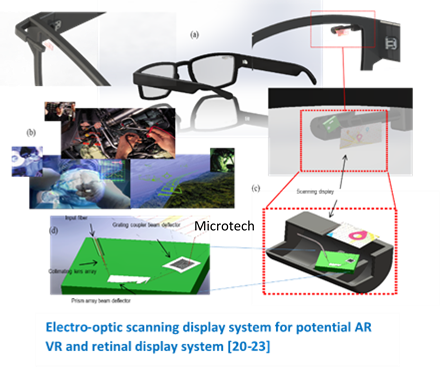
Building on those foundations, we moved from mechanical motion to light-driven control - developing electro-optic (EO) scanners that steer light without any moving parts. Using electro-optic polymers, liquid crystals, and gradient-index designs, our goal was to make scanners faster, smaller, and more precise (see figure below).
This work was supported by the Taiwan Ministry of Science and Technology (MOST) and integrates polymer and prism-based deflectors for high-speed beam steering — key for next-generation AR/VR and microdisplay systems [20–23]. The electro-optic scanner replaces mechanical oscillation with voltage-controlled light deflection, paving the way toward flexible, programmable optics that can scan, focus, and display images in real time.
This shift marked the start of a new paradigm: optical systems that think and move like electronics.
The latest chapter in our research pushes scanning beyond visible light — into the mysterious world of terahertz (THz) waves. Instead of relying on mechanical parts, we now manipulate waves directly using metamaterials — specially engineered structures that bend and guide energy in ways nature never intended [5, 11, 17, 20–28].
In a MOST-funded project completed in 2021, we created a voltage-controlled 2D gradient metamaterial combining electro-optic polymers and fishnet structures for a portable THz imaging system. This non-mechanical scanner overcomes the speed and resolution limits of traditional systems. Our design achieved tunability comparable to liquid-crystal approaches (≈3%) but with a simpler, cleaner fabrication process [21, 25, 26].
A U.S. patent (US10288979) was granted in 2019 for this THz imaging system [26], and a recent prototype successfully captured the first image ever formed by a metamaterial structure — work now under review in Nature Photonics [28]. Another companion paper on liquid crystal (LC) modeling for electro-optic improvement was accepted with minor revision in Nature Scientific Reports [5].
Together, these projects have produced over 16 publications in the past decade and reveal a future where waves are shaped not by mirrors or motors, but by materials themselves.
4. Shapeshifting Surgery: The World’s First Programmable and Steerable Smart Catheter
Modern catheter procedures still rely on manual wire-guided systems, where success depends on a surgeon’s skill and experience. These tools are often rigid, limited in flexibility, and require multiple specialized catheters for different procedures — leading to longer operations, higher costs, and greater radiation exposure.
Our team set out to change that. We developed two robotic catheter systems, one programmable and one steerable, both built on smart polymer technology.
The programmable catheter uses an in-house shape-shifting polymer that can be preset into custom configurations — and even reprogrammed mid-procedure. The steerable version uses a unique polymer spring structure that allows real-time, joystick-controlled bending for dynamic navigation inside the body.
Both systems feature 3–5-axis motion control, PWM-based actuation, tactile and position sensing, and soft polymer tips for patient safety. They are scalable, cost-effective, and compatible with existing fabrication methods — making them ready for clinical integration. With FPGA-based deep-learning acceleration and AI-assisted navigation, they pave the way toward fully autonomous robotic surgery.
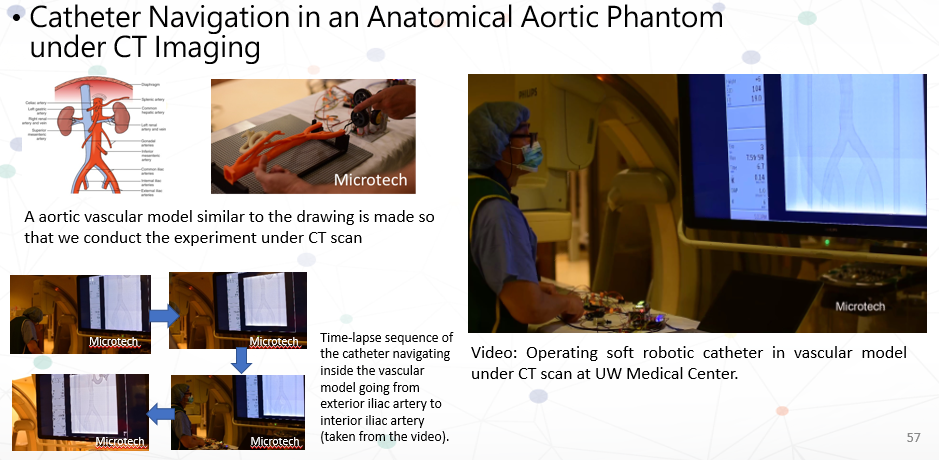
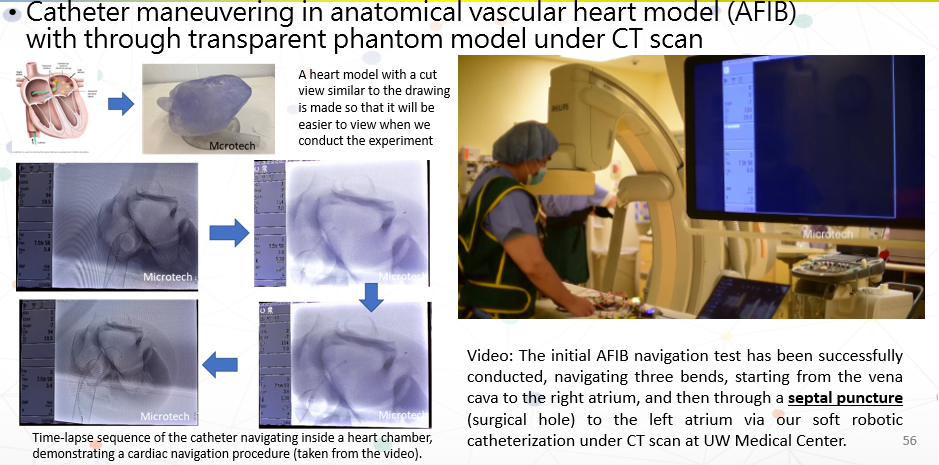
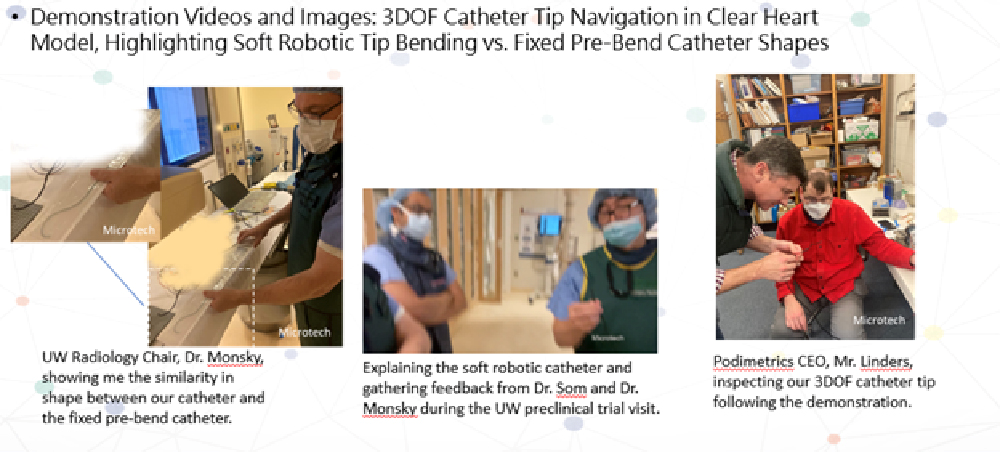
Extensive mechanical, environmental, biocompatibility, and aging tests have been and continuously being performed under FDA guidelines, alongside phantom and endovascular simulations under CT visualization at the University of Washington. The catheters navigated complex arterial and cardiac pathways with high precision under CT imaging (see figure below).
This work, protected by multiple U.S. patents [39–42], represents the first clinically demonstrated programmable and steerable catheter based on smart polymers. It marks a new era in minimally invasive medicine, combining advanced materials, robotics, and AI to create surgical tools that are smarter, faster, and safer than anything before.
5. Predicting the Heart’s Future: The World’s First Optical Waveguide-Based Blood Pressure and Heart-Rate Sensor
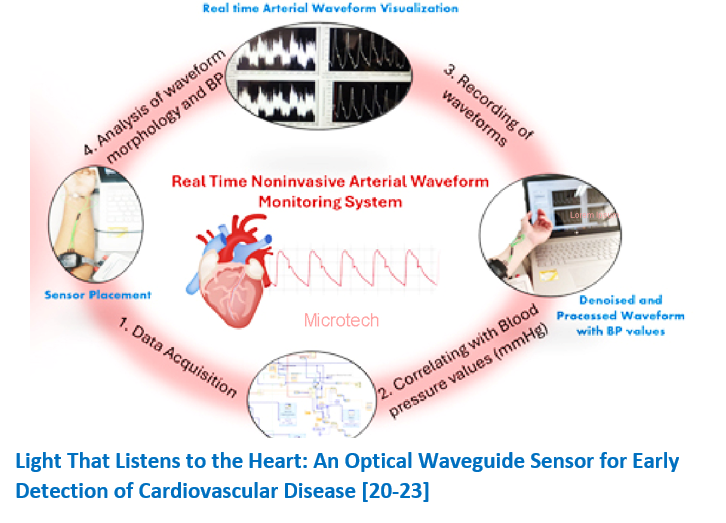
What if your watch could not only measure your heartbeat but also predict heart disease before it happens? Our team has created the first optical sensor that can do exactly that - measuring heart rate and blood pressure waveforms in real time with the accuracy of hospital-grade equipment.
Unlike traditional cuffs or invasive probes, this sensor uses a microscopic optical waveguide embedded in a wearable patch or wrist device. Each heartbeat changes the way light moves through the sensor — capturing data 20,000 times per second with precision of ±1 mmHg. It even adjusts automatically for different skin types and thicknesses, ensuring consistent performance for everyone.
In clinical studies with 184 participants, including patients with cardiovascular disease, the system matched gold-standard instruments while continuously tracking real-time pressure changes during normal motion and breathing. By analyzing these subtle light patterns, the technology can flag early warning signs of conditions such as atherosclerosis, heart attack, and cardiomyopathy - long before they become dangerous.
This innovation, protected under a U.S. patent [43], represents a turning point in heart health: where optics meets medicine, and a simple wearable could one day predict and prevent cardiovascular disease.
Referred Publications
-
[1] D. Schipf, W. C. Wang, “A Water Phase Mask for Optical Encryption Applications,” 2016 Frontiers in Optics: The 100th OSA Annual Meeting and Exhibit/Laser Science XXXII, 17 - 21 Oct 2016 in Rochester, NY.
-
[2] D. Schipf, W.C. Wang, “Optical encryption using a liquid phase mask,” OSA Cont, 1(3), 1026-1040, 2018.
-
[3] D. Schipf, W.C. Wang, “Measurement and modeling of Electrowetting Lens Oscillations using Digital Holographic Interferometry and Bessel and Legendre polynomial functions,” Optics Express, Vol. 27, Issue 12, pp. 17274-17282, 2019.
-
[4] W.C. Wang, Fluid-optical encryption system and method thereof (US11310392B2), granted 2021.
-
[5] V. Ghorapade, W.C. Wang, “Electro-Hydrodynamic Programming Reshapes Liquid Crystal Dynamics in Free-Form Director Fields,” Nature Scientific Reports, accepted, Vol. 10, article 4226, 2024.
-
[6] V. Ghorapade, W.C. Wang, “Simulating and Experimentally Verifying the Effects of LC Thickness and Voltage on Liquid Crystal Model Performance,” Optics Express, in revision, 2023.
-
[7] “Reconfigurable structure and tunable EM properties using amorphous materials and structures” (JAP110043).
-
[8] W.C. Wang, P. Garu, “Design of an Ultra Wideband Omnidirectional and Polarization Insensitive Flower Petal Antenna for Potential Ambient Electromagnetic Energy Harvesting Applications,” Nature Scientific Reports, 12:6096, 2022.
-
[9] P. Garu, W.C. Wang*, “A novel approach on design of a logarithmic spiral antenna for polarization and incident angle insensitive broadband electromagnetic wave absorption,” Appl. Physics, 133, 094901, 2023.
-
[10] A. Wegroski, W.C. Wang, C. Tsui, “Three cases of discontinuous refractive index in metamaterial study,” Nature Scientific Reports, 12:3558, 2022.
-
[11] Antoine Wegroski, Wei-Chih Wang*, Chileung Tsui, Prabir Garu, “Negative refractive index modified fishnet enhancement by wire shift,” Mater. Res. Express, 9, 095801, 2022.
-
[12] P. Garu, W.C. Wang, “Design and Analysis of a PDLC-Based Reconfigurable Hilbert Fractal Antenna for Large and Fine THz Frequency Tuning,” Micromachines, 13(6), 964, 2022.
-
[13] “Design of polarization-insensitive ultra-wideband omnidirectional and polarization insensitive Duo Aloe Vera Cruces Concentricis antenna structure applied to electromagnetic wave energy absorber, thermoelectric energy harvester, photoconductive antenna, array antenna and rectenna” (JAP110077-US /CP-5408-US/ P2021A0059).
-
[14] “Augmented logarithmic spiral antenna structure applied to electromagnetic wave energy absorber, thermoelectric energy harvester, photoconductive antenna, array antenna and rectenna” (JAP110076-US /CP-5407-US/P2021A0059).
-
[15] “Scanning Based THz Nearfield Scanning Imaging Device” (PCT/US22/19855/JAP110040).
-
[16] “Terahertz transceiver and method of fabricating the same” (PCT/US22/1753202/23/2022/JAP110041).
-
[17] S. Kalel, W.C. Wang, “Realization of Broadband Negative Index in Terahertz Band by Multilayer Fishnet Metamaterial Approach,” PIER C, Vol. 132, 159-170, 2023.
-
[18] K. Muthuramalingam and W.C. Wang, “Design and Analysis of Minkowski Fractal Antenna for Wideband THz Frequency Tuning/Multiband Operation in a MIMO Antenna System,” Appl. Phys., 133, 204902, 2023.
-
[19] S. Kalel, W.C. Wang, “Optical properties of PVDF-TrFE and PVDF-TrFE-CTFE films in terahertz band,” Mater. Res. Express, 10, 045304, 2023.
-
[20] F.J. Hsieh, W.C. Wang, “Full Extraction Methods to Retrieve Effective Refractive Index and Parameters of a Bianisotropic Metamaterial Based on Material Dispersion Models,” J. of Appl. Phys., 112(6), 064907-1–11, 2012.
-
[21] C.L. Chang, W.C. Wang, F.J. Hsieh, H.R. Lin, E. Pun, C. Chan, “Tunable Terahertz Fishnet Metamaterial,” Applied Physics Letters, Vol. 102, Issue 15, 2013.
-
[22] H.R. Lin, W.C. Wang, “Midinfrared radiation energy harvesting device,” J. Photon. En., 7(3), 038001, 2017.
-
[23] Antoine Wegrowski, Wei-Chih Wang, “Rotation Effect on Two Layer Fishnet Metamaterial,” 2018 IRMMW-THz, Nagoya, Japan, Sept. 9–14, 2018.
-
[24] W.C. Wang, Y.T. Cheng, “Cellulose nanoporous foam filled multi-layered split ring THz Sensor,” SPIE Symposium on Smart Structures and Materials + NDE, March 3–7, 2019, Denver, Colorado.
-
[25] H.H. Chen, C.L. Tsui, W.C. Wang, “Simulation study and experimental confirmation of a tunable THz negative-refractive index metamaterial,” SPIE Photonics West, OPTO, 1–6, Feb. 2020, San Francisco, CA.
-
[26] “Terahertz imaging system using tunable fishnet metamaterial” (US10288979, granted 2019).
-
[27] W.C. Wang, C. Tsui, A. Wegroswki, “Discontinuous refractive index in metamaterial study,” SPIE Symposium on Smart Structures and Materials + Nondestructive Evaluation and Health Monitoring, 12–16 March 2023, Long Beach, CA, USA.
-
[28] W.C. Wang, C. Tsui, G. Mo, “Investigation of THz imaging using a PLDC based gradient metamaterial array,” Nature Photonics, in review, 2023.
-
[29] W.C. Wang*, M. Li, K. Peng, Y. Hsu, B. Estroff, P. Yen, D. Schipf, and W. Wu, “Advancements in Microscopic Imaging: Harnessing Nonlinear Vibration with Aerosol-Jetted PZT-Actuated Fiber MEMS Scanner,” Nature Microsystems & Nanoengineering, Vol. 10, article 13, 2024.
-
[30] W.C. Wang*, M. Fauver, J.N. Ho, E.J. Seibel, P.G. Reinhall, “Micromachined optical waveguide cantilever as a resonant optical scanner,” Sensors and Actuators A: Physical, 102(1–2), 165–175, 2002.
-
[31] R. Panergo, C. Huang, C. Liu, P. Reinhall, W.C. Wang^, “Resonant polymeric optical waveguide cantilever integrated for image acquisition,” Journal of Lightwave Technology, 25(3), 850–860, 2007.
-
[32] W.C. Wang*, P. Reinhall, “Scanning polymeric waveguide design of a 2D display system,” IEEE Journal of Display Technology, 4(1), 28–38, 2008.
-
[33] W.C. Wang, C. Tsui, “Two-dimensional mechanically resonating fiber optic scanning display system,” Optical Engineering, 49(9), 097401–097401-8, 2010.
-
[34] W.C. Wang, Jun Lo, Alex Jen, “Electro-optic polymer prism beam deflector,” Optical Engineering, 48(11), 114601, 2009.
-
[35] W. Hua, W. Wu, W.C. Wang*, “Development of 2D Microdisplay Using an Integrated Microresonating Waveguide Scanning System,” Journal of Intelligent Material Systems and Structures, 22(14), 1613–1622, 2011.
-
[36] W.C. Wang, C. Tsui, “1-D electro-optic beam steering device,” Sensors and Actuators A: Physical, 188, 277–284, 2012.
-
[37] W.C. Wang, C. Tsui, K. Gu, “Design and Fabrication of a Push-Pull Electrostatic Actuated Cantilever Waveguide Scanner,” Micromachines, 10(7), 432, 2019.
-
[38] Yen-Chieh Huang, Luo-Hao Peng, Hossein Shirvani, Wen-Chi Chen, Karthickraj Muthuramalingam, Wei-Chih Wang, Andrzej Szczepkowicz, “Single-electron Nano-chip Free-electron Laser,” APL Photonics, 7(13), 096101, 2022.
-
[39] “MULTI-DEGREE-OF-FREEDOM STEERABLE CATHETER SOFT ROBOTIC SYSTEM, METHODS OF MANUFACTURING A STEERABLE CATHETER, AND OPERATING” (US/JAP110038-US).
-
[40] “METHOD FOR PREPARING CARBON NANOTUBE/SHAPE MEMORY POLYMER FOAM COMPOSITE, AND CATHETER SYSTEM USING AN ACTUATOR MADE OF CARBON NANOTUBE/SHAPE MEMORY POLYMER FOAM COMPOSITE” (PCT/JAP112070-US).
-
[41] “Self-Sensing Soft Robotic Polymer Spring-Actuated Catheter System” (Filed 10/1/25).
-
[42] “Continuation-in-Part (CIP) of ‘Method for Preparing Carbon Nanotube/Shape Memory Polymer Foam Composite, and Catheter System Using an Actuator Made of Carbon: cardiac and endovascular applications’” (Filed 10/1/25).
-
[43] “PULSE MONITORING DEVICE AND SYSTEM INCLUDING THE SAME” (US/JAP110039-US).